
The Soul of the Korean Table: Why a Meal in Korea Is Never Just a Meal
, by Jun Sung Lee, 9 min reading time
, by Jun Sung Lee, 9 min reading time
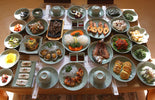
 One bowl of rice, many shared dishes — the Korean table is built for togetherness. Photo: Korea Gateway.
Before Korean food was a global trend, it was a table — shared, unhurried, and full of warmth. To understand the Korean restaurant, you have to start where it began: not with an export figure, but with a bowl of soup that has been served the same way for over a century.
In Korea, the most common greeting is not "How are you?" It is "Have you eaten?" (bap meogeosseo?). That single phrase holds the whole philosophy of the Korean table: to care for someone is to feed them. A meal is not fuel. It is a way of saying you matter to me.
This is why a Korean table looks the way it does. One bowl of rice per person, and then a constellation of shared dishes — banchan — placed in the middle for everyone to reach. The kimchi, the namul, the jjigae bubbling in a single pot that many spoons enter. The architecture of the table is the architecture of community. You do not eat beside people in Korea. You eat with them, from the same dishes, at the same time.
A Korean restaurant, then, is not a place that sells food. It is a place that hosts this ritual for strangers — and somehow makes it feel like home. That is the thing no algorithm can generate and no supply chain can ship.
Walk a back street in Jongno, Seoul, and you can still eat at Imun Seolnongtang. It opened in 1902 — holding the city's restaurant license No. 1 — and for more than 120 years it has served essentially one thing: seolleongtang, a milky beef-bone soup, simmered clear and unseasoned, so each guest salts it to their own taste at the table. The recipe has barely changed across four generations of owners.
Korea calls these places nopo — old houses. Because of the Japanese occupation and the Korean War, almost no Korean restaurant survives past a hundred years; the ones that do are treated as living history. Seoul has formally designated some 50 of them as "Future Heritage" — Imun (1902), Woo Lae Oak (1946, Pyongyang-style naengmyeon), Hanilkwan (1939, galbi), Cheongjinok (1937, haejang-guk), Yonggeumok (1932, chueo-tang). Each one is a single dish, perfected over generations, in a city that rebuilt itself around them.
Seolleongtang itself is said to trace back to Seonnongdan, a royal rite where the king offered a sacrifice and shared a communal soup with his people. A bowl of it is not just lunch. It is a thread running back through a century of a country that kept changing — except, for one hour, at this table.

Korean restaurant culture is not one room. It is a different room for every chapter of a life, and each has its own rhythm.
The baekban house — a bowl of rice and a spread of banchan for a few thousand won — is the honest, everyday lunch of working Korea. The hanjeongsik, by contrast, is the full-court feast: dozens of dishes arriving in sequence, the heritage of royal-court dining, reserved for celebration. The gogi-gip — the grill house — is where Korea holds its evenings: colleagues over soju, families over samgyeopsal, the table itself alive with fire and smoke. Bunsik — the tteokbokki-and-kimbap snack shops — is the taste of being young, of after-school and late nights. And the pocha, the street tent under orange light, is where the city goes to be honest after midnight.
To eat across these formats is to read a culture's emotional life — when it works, when it celebrates, when it grieves, when it falls in love. The food is the menu. The room is the meaning.
Here is the quiet crisis. Nopo close. An owner retires with no successor, a building is redeveloped, and a recipe that took a century to perfect disappears in a week. The greeting "have you eaten?" survives, but the houses that answered it do not always make it to the next generation.
This is why Korea Gateway exists. We believe the soul of a Korean restaurant — the founder's story, the room, the single dish and why it never changed — deserves to be recorded as a permanent archive, not left to fade or flatten into a star rating. A review tells you whether to go. A record makes sure the place is never truly lost.
Most of these restaurants already hold their own story — in their walls, their regulars, their photographs, their decades. What they have rarely had is someone to set it down for good. That is the work we care about most.
If you run one — or love one — Korea Gateway records the people, rooms, and dishes that define Korean dining, so they last.
Get Featured →